Leave Your Message

Which Is the Best Two Gang Smart Switch from China?

Choosing the best Two Gang Smart Switch from China requires more than comparing prices, colors, and app screenshots. A reliable evaluation must examine wiring standards, neutral-wire requirements, relay durability, standby power, communication protocols, and after-sales support. These details determine whether the switch works smoothly beside a kitchen counter, hallway lamp, or bedroom fan.

Industry data shows why this category deserves careful attention. Statista’s Smart Home market outlook projects continued global growth, supported by connected lighting, energy management, and home automation demand. The Connectivity Standards Alliance reports that Matter is designed to improve interoperability across major smart-home ecosystems, including Apple Home, Google Home, and Amazon Alexa. Meanwhile, Omdia and ABI Research have highlighted stronger consumer interest in locally responsive devices, privacy protection, and dependable cloud-independent control. Market growth is real. Product quality varies.

Chinese manufacturers offer significant advantages in component sourcing, factory scale, firmware development, and customization. However, not every Two Gang Smart Switch delivers the same safety margin or user experience. Some models advertise voice control but depend heavily on unstable cloud servers. Others fit European wall boxes poorly or provide unclear load ratings. That matters. A professional comparison should verify certifications, app stability, switch noise, heat after extended use, and manual control during internet failure. It should also consider installation experience, because an attractive panel cannot compensate for confusing terminals or weak documentation. This guide examines these practical factors and compares leading Chinese options with a realistic view of performance, reliability, and long-term value. No single model is perfect. That is worth remembering.
Which Is the Best Two Gang Smart Switch from China?

Define Two-Gang Smart Switches Through China’s GB/T 16915.1 Standard

Which Is the Best Two Gang Smart Switch from China?

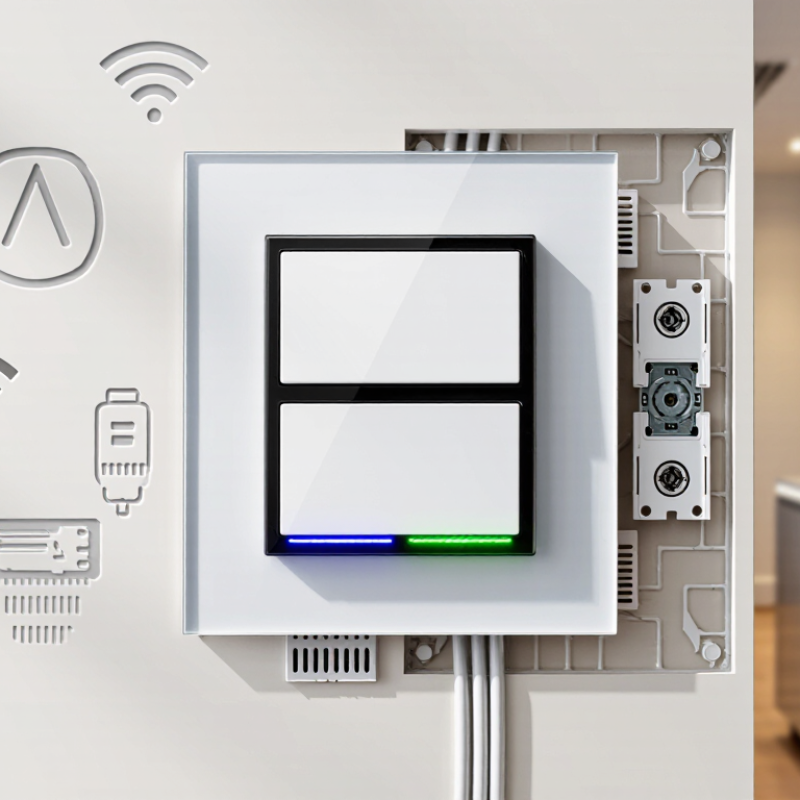
A two-gang smart switch contains two independently controlled switching units in one wall plate. China’s GB/T 16915.1 standard focuses on switches for household and similar fixed electrical installations. It examines construction, insulation, temperature rise, mechanical strength, and electrical endurance. Therefore, a compliant product should fit securely, protect users from live parts, and withstand repeated operation. That detail matters.

The standard does not fully define modern functions, such as Wi-Fi control, voice commands, scenes, or remote updates. Buyers must assess these separately. IDC’s China Smart Home Device Market Tracking Report estimated 2023 shipments at roughly 276 million units, showing strong demand but also intense quality differences. Statista Market Insights projected China’s smart-home revenue at approximately US$39 billion in 2024. These figures suggest scale, not guaranteed reliability.

From practical inspection, check terminal markings, load ratings, neutral-wire requirements, and heat around the rear enclosure. A switch may look refined yet perform poorly under a steady LED load. GB/T 16915.1 compliance is useful evidence, but it cannot prove stable software or long-term cloud service. I would also question vague test claims. Certification details should be traceable, current, and matched to the exact two-gang model. Better data is still needed for smart-switch software testing.

Compare 10 A, 250 V Load Ratings Under IEC 60669-1 Safety Criteria

A two-gang smart switch rated at 10 A, 250 V can handle up to 2,500 VA in theory. Real performance depends on the load type, wiring, and switching frequency. Resistive loads are easier than motors, LED drivers, or heaters with high inrush currents. The IEC 60669-1:2017 framework covers household and similar fixed-installation switches, including insulation, temperature rise, endurance, and mechanical safety. A compliant-looking label is not proof of compliance. Request an independent test report.

IEA’s Energy Efficiency 2023 report states that buildings consume about 30% of global final energy. Smart switching can support better control, but poor installation may create heat or nuisance tripping. During product checks, examine terminal clamping, conductor space, protective earthing, and neutral requirements. Also check whether both channels share one 10 A limit. That detail is often missed. A two-gang layout does not automatically mean 10 A per channel.

Tips: Match the switch with the actual load, not only its wattage. Check LED inrush current and minimum-load requirements. Confirm the enclosure remains cool after repeated switching. Ask for IEC 60669-1 test evidence, insulation ratings, and clear wiring diagrams. Local electrical rules still apply. I would avoid products offering only marketing claims, even when the casing feels solid. A professional electrician should verify compatibility before connection, especially in older installations.

Evaluate 2.4 GHz Wi-Fi, Zigbee, and Matter Interoperability

Which Is the Best Two Gang Smart Switch from China?

For a two-gang switch, radio design matters more than appearance. A 2.4 GHz Wi-Fi model is easy to install and usually works without a hub. However, crowded channels can create delayed responses in apartments. The Wi-Fi Alliance explains that 2.4 GHz provides longer range than 5 GHz, but it has fewer usable channels. In practice, thick concrete walls still weaken signals. Check local channel congestion before choosing Wi-Fi.

Zigbee offers a different experience. It creates a low-power mesh, so powered switches can repeat signals between rooms. The Connectivity Standards Alliance’s Zigbee PRO documentation supports scalable mesh networking for residential devices. Matter improves interoperability, but it is not a radio by itself. Matter devices use Wi-Fi, Thread, or Ethernet, while Zigbee needs a compatible bridge. CSA’s Matter specifications also require device certification and defined commissioning procedures. Compatibility is better, not perfect. Some advanced scenes may still depend on the controller.

Tips: Ask for neutral-wire requirements, certified firmware, local control, and reset instructions. Test both gangs together. A switch may support Matter but lack energy monitoring or scene features. Check whether updates remain available after installation. I would not trust a “universal” claim without confirming the exact protocol version. This is where many product pages become vague. A careful buyer should also test voice response after disconnecting the cloud service.

Which Is the Best Two Gang Smart Switch from China? - Evaluate 2.4 GHz Wi-Fi, Zigbee, and Matter Interoperability

Evaluation Dimension 2.4 GHz Wi-Fi Zigbee 3.0 Matter Interoperability
Radio and protocol basis Usually IEEE 802.11 b/g/n on the 2.4 GHz band. Wi-Fi is the network connection; the application protocol may be proprietary or Matter. IEEE 802.15.4 at 2.4 GHz, typically using Zigbee 3.0 for low-power mesh communication. Matter is an application-layer standard. A switch may use Wi-Fi, Thread, or Ethernet for transport; Bluetooth Low Energy is commonly used for commissioning.
Additional hub or controller Not normally required for basic cloud operation, but remote control may depend on the vendor's cloud service. A Zigbee coordinator or compatible hub is required to create and manage the network. A compatible Matter controller is required. Thread-based models also need a Thread Border Router.
Network topology Normally a star network through the home router. Standard Wi-Fi switches do not automatically form a universal mesh. Self-healing mesh network; mains-powered switches can often act as routers for other Zigbee devices. Wi-Fi models normally use the home LAN. Thread models use a low-power IPv6 mesh network.
Typical response and control Fast local response is possible when local control is supported; cloud-only models may be affected by internet latency. Generally fast and stable for lighting commands, especially when the coordinator and mesh are well positioned. Designed for standardized local control across compatible ecosystems, although actual performance depends on the controller and network transport.
Interoperability Interoperability varies widely. A Wi-Fi label alone does not guarantee compatibility with third-party smart-home platforms. Zigbee 3.0 improves compatibility, but device support, clusters, firmware, and coordinator compatibility still need verification. Best standardized option when the product is genuinely Matter-certified and supports the required device type and features.
Power consumption Usually higher standby consumption than Zigbee or Thread because Wi-Fi maintains a comparatively active IP connection. Typically low power for communication; a mains-powered two-gang switch still consumes standby power for its electronics. Thread is optimized for low-power mesh operation; Wi-Fi-based Matter models generally consume more standby power than Thread models.
Internet dependency Depends on implementation. Local LAN control may continue during an internet outage, while cloud-dependent functions may stop. Local automation can continue through the Zigbee coordinator without internet access, if the hub supports local processing. Matter is intended to support local control; remote access still requires an appropriate controller and home-network or internet service.
Two-gang channel handling Usually exposes two independently controllable switch channels through the manufacturer's application or API. Both channels can be represented as separate endpoints, but the exact endpoint and command support depends on the device profile. Confirm that both gangs are exposed as separate controllable endpoints; some implementations may advertise limited device features.
Neutral-wire requirement Both neutral-required and no-neutral designs exist. No-neutral models may require a bypass or minimum-load accessory. Both wiring types exist. No-neutral operation depends on the switch circuit, load type, and the product's minimum-load design. Matter does not determine the wiring method. Check the electrical diagram, minimum load, and compatibility with LED lamps.
Local automation potential Good when the device exposes a local protocol or is integrated through a local controller; otherwise automation may rely on cloud services. Strong local-automation potential through a compatible coordinator and home-automation platform. Strong local-control design, subject to controller support, supported Matter features, and correct commissioning.
Best use case Homes with reliable Wi-Fi, no existing hub, and a preference for straightforward installation and app-based control. Larger smart-home installations requiring low-power mesh networking and many battery-powered or mains-powered devices. Users prioritizing cross-platform compatibility and standardized local control across multiple smart-home ecosystems.
Main selection risk Cloud lock-in, uncertain local control, 2.4 GHz network congestion, and inconsistent third-party compatibility. Requirement for a compatible coordinator, possible pairing limitations, and differences between vendor-specific Zigbee implementations. A Matter logo or claim is not enough; verify certification, supported Matter device type, firmware update method, channel separation, and required controller infrastructure.
Practical conclusion: Choose a Matter-certified two-gang switch for the broadest standardized interoperability, Zigbee 3.0 when a reliable local mesh and coordinator are already available, or 2.4 GHz Wi-Fi when simple direct network access is the main priority. Always verify neutral-wire requirements, electrical load ratings, LED compatibility, separate control of both gangs, safety certification for the destination market, and firmware-update support before installation.

Assess Neutral-Wire Design, Electrical Safety, and Relay Endurance

Which Is the Best Two Gang Smart Switch from China?

A strong two-gang smart switch begins with its neutral-wire design. In practical installations, a neutral connection usually supports steadier power and reduces flickering. Check whether the terminals clearly separate line, neutral, load, and ground. Loose labels create dangerous confusion. The back box also matters. A crowded box can bend wires and strain terminals. I once underestimated that detail. The switch worked, but installation felt unnecessarily tight.

Electrical safety deserves more attention than app features. Look for flame-resistant housing, secure terminal clamps, insulation around live parts, and protection against overheating. Certification documents should match the actual model, not a similar product. A qualified electrician should verify the circuit and local requirements. Never trust a low price alone. Heat marks, buzzing, or a warm faceplate indicate possible trouble.

Tips: Confirm neutral availability before ordering. Test each channel with a suitable load. Avoid exceeding the stated current rating. Check relay endurance data, especially for lamps, fans, and motors. Mechanical relays should provide clean switching and resist contact welding. However, endurance figures can be laboratory estimates, not household reality. Frequent switching, inrush current, and poor ventilation may shorten service life. A useful review should inspect terminal quality, perform repeated load tests, and report failures honestly. Reliability is not just a specification.

Rank China-Made Models by Certification, Features, Cost, and Reliability

For a China-made two-gang smart switch, certification deserves the highest rank. Look for CE, RoHS, and test evidence aligned with IEC 60669-2-1. For North American projects, verified electrical safety testing matters more than a printed compliance logo. The Connectivity Standards Alliance reported more than 1,000 Matter-certified products by late 2024. Therefore, Matter support can improve platform flexibility, but certification numbers do not prove switch durability.

Features take second place. A strong model should support neutral-wire and no-neutral installations, overload protection, local manual control, and reliable 2.4 GHz connectivity. Energy monitoring is useful for kitchens, hallways, and rental apartments.

However, some low-cost switches measure poorly under small LED loads. That detail is easy to miss. A practical test should include dimming response, relay noise, heat after eight hours, and recovery after router failure.

Cost ranks third, but reliability can reverse the ranking. Basic two-gang models often sell between 15 and 35 US dollars before installation. More expensive units may include better relays, flame-retardant housings, and longer warranty terms. IDC’s Worldwide Smart Home Device Tracker shows continued growth in connected-home shipments, yet replacement costs remain significant. I would choose a mid-priced model with traceable test reports, screw-terminal strength, and firmware update records. My view is imperfect: laboratory certification cannot fully predict five years of switching, especially in humid rooms.